Commonly seen overseas, boarding by groups or zones will be trialled in Australia from next week.
Qantas will introduce ‘boarding groups’ for domestic flights next week, with the program kicking off at Brisbane ahead of a rollout at other major airports and “a wider implementation in October 2023.”
The airline will test the concept on selected flights from Brisbane’s domestic terminal, with travellers being “contacted in advance if their flight is involved in a trial.”
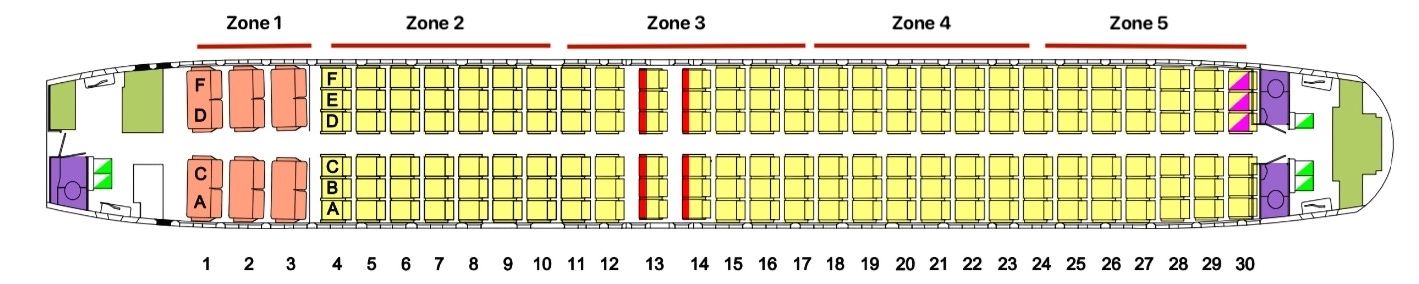
Aircraft will be divided into five zones and passengers assigned to one of five boarding groups as the airline seeks to streamline the current boarding process, to make the start of the journey smoother for passengers and help more flights get away on time.
Digital and printed Qantas boarding passes will include the passenger’s boarding group, while there will also be revised boarding gate layouts, signage and announcements.
It’s far from innovative – most North American and many European airlines already pre-sort passengers into groups based on their frequent flyer status or where they are seated – but as most international travellers can attest, the system works well when it’s properly managed and policed at the gate.
Travellers involved in the trials will be invited to participate in a survey to rate the process.
Qantas’ current boarding process for domestic flights involves just two lines – a priority boarding line for business class passengers and top-tier frequent flyers, and a second line for everybody else.
So how will the new Qantas boarding procedure work?
Qantas priority boarding
What most travellers know as Qantas priority boarding is what Qantas calls ‘premium boarding’ – but it’s the same thing and will remain in place for anybody in business class, along with Chairman’s Lounge members and Platinum- or Gold-grade frequent flyers regardless of where in the plane they are sitting.
Travellers eligible for priority boarding will be invited to board the plane first, but can of course walk up at any time (as many prefer to stay a little longer in the lounge before heading to the departure gate).
Qantas boarding groups
The economy cabin will be divided into four sections – for ease of references, let’s call them zones 2, 3, 4 and 5 going from front to back (assuming that the business class cabin is zone 1).
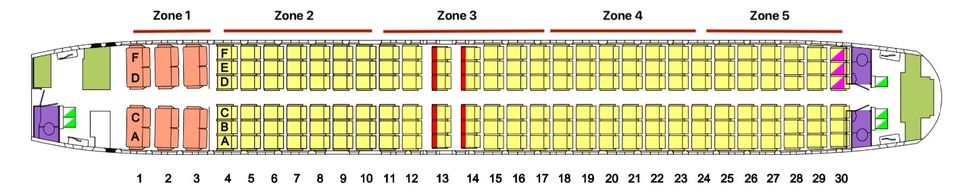
An example of how Qantas’ boarding zones will work.
Qantas has not decided on how it will refer to these zones, either by numbers or letters, so right now those numbers are simply to help communicate the order in which economy passengers will board the flight.
Passengers in the ‘front middle’ and ‘back middle’ zones – respectively 3 and 4, in our example – who don’t hold Gold or higher status will be called first, with the ‘front middle’ block boarding from the front of the plane and the ‘back middle’ block using the rear door.
Once they’ve settled in, passengers in the very front and very back (which we’re calling zones 2 and 5) will then board the plane, respectively from the from and rear doors.
At the Qantas departure gate
As a result of the more structured front-and-back boarding, the domestic departure gates will effectively see passengers divided into three groups:
- one group will be for everyone eligible for Qantas priority boarding
- a second group will be for everyone boarding through the front door (zones 2 and 3, in our example), and
- a third group will be for everyone boarding through the rear door (zones 4 and 5, in our example)
Qantas says it will reorganise the seating and layout of its departure gates to support this grouping, reduce congestion at the gate and minimise how long passengers spend standing in a line that slowly shuffles forward.
There will also be digital signage at the gates to help direct passengers to the appropriate group, while their individual boarding groups or zones will appear on their printed or digital boarding pass.
How Qantas will trial boarding groups
Qantas says it will begin trialling this new domestic boarding system in June, on selected flights from Brisbane.
After assessing how the system works in practice and what other measures might help streamline the boarding process, more Brisbane routes will then be added to the trial; other domestic airports will then follow, with a national rollout in place by October.